The Next Evolution of Insurance Distribution
The Next Evolution of Insurance Distribution
By Joe Ramos | Pulse Point Management
The insurance industry is entering one of the most significant transformations in its history. Artificial intelligence, digital infrastructure, regulatory technology, and cybersecurity are rapidly reshaping how insurance products are manufactured, distributed, and serviced.
But the real shift is not the elimination of distribution.
It is the integration of the insurance ecosystem.
At Pulse Point Management, we see five structural forces defining the next generation of InsurTech.
- The Platform Layer Will Connect the Ecosystem
Insurance distribution has historically operated through fragmented layers:
Carrier → BGA → IMO → Advisor → Consumer
These layers often function independently, slowing communication, underwriting decisions, compliance workflows, and policy placement.
The next generation of InsurTech platforms will not control distribution—they will integrate it.
Modern platforms will facilitate faster and more seamless connectivity between carriers, distributors, advisors, and technology providers while unlocking the value of decades of historical data across the industry.
When combined with AI and automation, this connectivity improves:
- underwriting insights
• product matching
• placement ratios
• compliance oversight
• client servicing
The future platform layer will act as the connective infrastructure that makes the entire insurance ecosystem more intelligent and efficient.
- AI Will Compress the Insurance Value Chain
AI is not replacing insurance professionals.
It is replacing friction.
Processes that once took weeks—from client intake to underwriting review—are increasingly being streamlined through automation and data-driven decision support.
AI will significantly improve:
- case design
• underwriting analysis
• policy comparisons
• compliance monitoring
• servicing workflows
The result is a faster and more scalable insurance marketplace.
- The Future of Distribution Is Hybrid
Insurance will not become purely digital or purely human.
It will become hybrid.
Consumers increasingly research online, but complex financial decisions—especially around life insurance, estate planning, and retirement—still require trusted advisors.
Technology will simplify the data and product analysis.
Advisors will remain essential for strategy, trust, and decision-making.
- Compliance and Cybersecurity – More important than ever
As insurance distribution becomes more digital, regulatory oversight and cybersecurity risks increase.
Modern distribution ecosystems require integrated frameworks for:
- compliance monitoring
• cybersecurity protection
• licensing management
• regulatory automation
These capabilities are no longer support functions—they are foundational infrastructure for operating at scale in a digital insurance environment.
- Distribution Consolidation Is Accelerating
Insurance distribution remains highly fragmented, with thousands of IMOs, BGAs, and agencies operating with limited technological infrastructure.
Over the next decade we expect consolidation driven by:
- technology requirements
• regulatory complexity
• operational scale
• capital investment
The organizations that combine distribution, technology, compliance, and data intelligence will lead the next generation of the insurance industry.
The Pulse Point Perspective
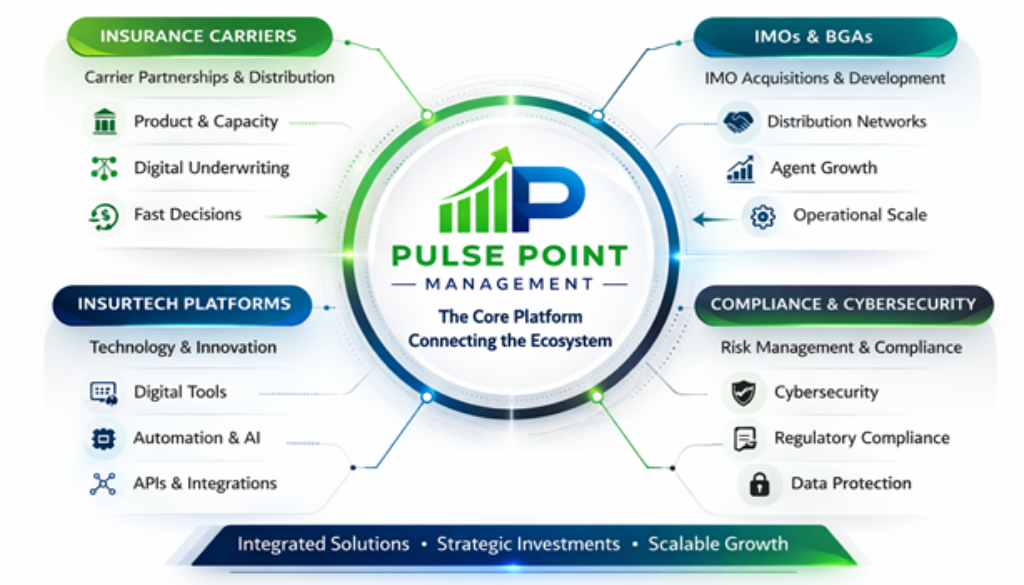
At Pulse Point Management, our focus is building the infrastructure that connects the insurance ecosystem.
This includes:
- acquiring and scaling distribution organizations
• enabling carrier distribution connectivity
• deploying InsurTech infrastructure
• integrating cybersecurity and compliance frameworks
• leveraging AI and data across the insurance lifecycle
The future of insurance will not be defined by a single technology or channel.
It will be defined by how well the ecosystem connects.
Those who build the infrastructure that integrates carriers, distributors, technology platforms, and regulatory frameworks will define the next era of insurance.